Smart thermostat vs programmable thermostat: is the upgrade worth it?
See which one fits your routine, wiring and budget.
As an Amazon Associate we earn from qualifying purchases. Product links on this page are affiliate links: buying through them costs you nothing extra and does not change what we recommend.

ecobee Smart Thermostat Essential
Best for: Homes with a C-wire, or owners ready to add ecobee’s Power Extender Kit.
- Lower entry price into the ecobee app and schedules
- ENERGY STAR certification, which some utility rebates require
- No C-wire? Budget for the separate Power Extender Kit
- No remote room sensor in the box
Name, photo and listed features checked on Amazon.com on November 14, 2026. We have not tested it; see how we choose.
Which one should you pick?
A smart thermostat adjusts from your phone, can detect when you are away, and can learn or follow your routine.
ENERGY STAR certified smart thermostats are designed to work with some utility programs; programmable models are not part of the ENERGY STAR program.
Many programmable models run on batteries and need no C-wire; check the lease before swapping either type.
Either type must support heat pumps and auxiliary heat; smart models with room sensors help, but a basic heat-pump programmable can be enough.
Smart thermostat vs Programmable thermostat
| What changes | Smart thermostat | Programmable thermostat |
|---|---|---|
| How it saves | — | A fixed weekly schedule; DOE says up to 10% a year from a 7–10°F setback for 8 hours a day when the schedule is actually used |
| ENERGY STAR status | Certified models exist (spec effective Jan. 1, 2017) | The program suspended its programmable thermostat specification at the end of 2009 over questions about net savings |
| Wi-Fi and app | Yes: remote control, alerts, energy reports | No, or a limited feature set |
| Learning and presence detection | Often: learns your routine, uses your phone or built-in sensors to detect when you are away | No: it follows the program you enter |
| Remote room sensors | Available on many models, to read a bedroom or a cold room | Rare |
| Power and wiring | Usually wants a C-wire, power adapter or battery assist; see the wiring guide | Often runs on batteries and needs no C-wire |
| Utility rebates and demand response | Often eligible; ask your utility | Rarely eligible |
| Ease of use | App and touchscreen; more menus, more to set up | Buttons and a small screen; schedule entered by hand |
| Cybersecurity and data | Needs an account, firmware updates and a strong password | No network connection, no data sharing |
The savings come from the schedule, not the label
Both types save energy the same way: by lowering the temperature when you do not need it. The Department of Energy says you can save as much as 10% a year on heating and cooling by turning the thermostat back 7–10°F for 8 hours a day. A programmable thermostat can do that on a fixed program. A smart thermostat can do it with a changing schedule, and it can adjust when you leave unexpectedly. ENERGY STAR reports that homes with certified smart thermostats save on average 8% on heating and cooling costs, based on field data.
So the upgrade pays when the cheaper thermostat would not be used well. If the schedule is wrong half the time, you override it and forget to change it back, a smart model with away detection can recover that savings. Estimate your own with the smart thermostat savings calculator.
When a smart thermostat is the better choice
- Your household schedule varies: shift work, travel, kids’ activities.
- You want to check or change the temperature away from home, or get an alert if the house gets too cold.
- One room is always off from the rest, and a remote sensor would help.
- Your utility offers a rebate or a demand response credit for a certified smart thermostat. See smart thermostat rebates and utility programs.
- You use a smart home system and want the thermostat in your routines.
See smart thermostat without a C-wire.
When a programmable thermostat is enough
- Your routine is steady, and you will program it once and keep it.
- You prefer no Wi-Fi, no app, and no cloud account.
- You rent a home with an older system and want a simple swap that can be reversed at move-out.
Pick a model for your system: heat pumps, electric baseboard, millivolt and multi-stage systems each need a matching model. The Department of Energy says electric resistance heating requires thermostats that control 120-volt or 240-volt circuits, and that heat pumps generally do not suit setbacks on a standard programmable thermostat. See thermostat settings that save money for a schedule.
A middle path
You do not have to choose permanently. Start with a programmable model, follow the schedule for a season, and upgrade if you keep overriding it. If you already own a smart thermostat, the most reliable use of it is a plain schedule with away detection turned on.
Products that match each need
Changing schedule, remote control, rebates
What to look for: ENERGY STAR certification, away detection, remote sensor support, a compatibility check for your wiring

Fixed routine, low budget
What to look for: 7-day programmable schedule, battery power with no C-wire, correct system type, clear display and hold button

Heat pump, simple schedule
What to look for: heat pump programmable model with auxiliary heat control, O/B terminal support, recovery or smart-start feature
Frequently asked questions
Is a smart thermostat worth it over a programmable one?
It is when your schedule changes, when you want remote control or room sensors, or when a utility rebate narrows the price gap. If you will set a schedule once and keep it, a programmable thermostat captures most of the same savings for less.
Do programmable thermostats save as much as smart ones?
They can, because the savings come from the setback. DOE says up to 10% a year for a 7–10°F setback for 8 hours a day. A smart thermostat helps when you would not keep the schedule.
Does a smart thermostat need a C-wire?
Most want one, or a power adapter. Some models use power stealing or batteries. Many programmable thermostats run on batteries and do not need a C-wire.
Are programmable thermostats ENERGY STAR certified?
Not under the current program. ENERGY STAR suspended its programmable thermostat specification at the end of 2009, citing questions about net energy savings, and certifies smart thermostats instead.
Sources
- ENERGY STAR — Technical bulletin: ENERGY STAR certified smart thermostats
- ENERGY STAR — Smart thermostats
- ENERGY STAR — Programmable thermostats specification (status: suspended)
- U.S. Department of Energy, Energy Saver — Thermostats
- Amazon.com listing: ecobee Smart Thermostat Essential - WiFi Thermostat, Energy Star Certified (ASIN B0DT9MC2Z9), checked November 14, 2026
- Amazon.com listing: ecobee Smart Thermostat Premium - WiFi, Siri & Alexa Built-In, Smart Sensor (ASIN B09XXS48P8), checked November 14, 2026
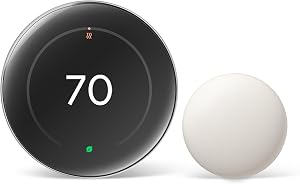
- Amazon.com listing: Google Nest Learning Thermostat (4th gen) + Nest Temperature Sensor (2nd gen) - Silver (ASIN B0D5BGST5N), checked November 14, 2026
Product names, photos and listed features were checked on the Amazon.com product pages on November 14, 2026. Prices and availability change; the retailer page is always the reference.
Related pages
 CalculatorSmart thermostat savings estimateEnter your heating and cooling costs, the setback you would use and the thermostat price to see a realistic savings range and payback, based on…GuideSmart thermostat rebates and free thermostat offers from utilitiesMany utilities discount or even give away smart thermostats. Learn where to look, what you agree to in demand response programs, and which questions…GuideWhat temperature to set your thermostat to save moneyThe Department of Energy points to 68–70°F when you are awake in winter, a setback of 7–10°F for 8 hours a day and 78°F in summer. Here is how to…GuideSmart thermostat without a C-wire: your real optionsNo C-wire at the wall plate? Most homes can still run a smart thermostat. Check your wiring in ten minutes, pick the fix that fits your system and…
 CalculatorDevice energy cost calculatorEnter watts (or amps), hours of use and your electricity rate to see what any appliance or smart device costs per hour, month and year, standby power…
 GuideEnergy-monitoring smart plugs: what the numbers meanAn energy-monitoring smart plug reports watts, kilowatt-hours and cost for what is plugged in. See what the readings mean, where they fall short and…