Self-emptying dock or manual bin: which robot vacuum fits you?
A self-emptying dock empties the dustbin for you but adds cost, bags and bulk. A manual bin is simpler and cheaper. See which one fits your floors, pets and budget.
As an Amazon Associate we earn from qualifying purchases. Product links on this page are affiliate links: buying through them costs you nothing extra and does not change what we recommend.
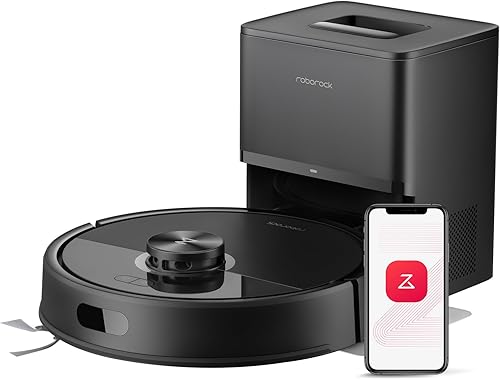
roborock Q7 M5+ robot vacuum and mop
Best for: Small apartments and homes with pets where daily vacuuming matters.
- Self-empty dock suits busy households and pet hair
- Vacuums and mops
- The dock needs floor space and an outlet
- Replacement bags are an ongoing cost
Name, photo and listed features checked on Amazon.com on November 14, 2026. We have not tested it; see how we choose.
Which one should you pick?
A small onboard bin fills quickly with hair. A dock that empties it into a larger bag means you handle debris every few weeks instead of after most runs.
The dock adds cost and takes up about as much floor as a small stool. Emptying a small bin over the trash takes under a minute.
Light use rarely overfills the bin, so the dock’s convenience matters less than its price and bag costs.
A sealed bag keeps the dust out of your hands. Check that the bag and dock have a filter, and remember that the dock itself is loud for a short burst.
Many makers sell the same robot with and without a dock, and some docks are sold separately. Check the listing before you assume you can add one later.
Self-emptying dock vs Manual dustbin
| What changes | Self-emptying dock | Manual dustbin |
|---|---|---|
| Who empties the dust | The dock, into a disposable bag or a bagless canister, every run or when the bin is full | You, from a small onboard bin, usually after every one to three runs |
| Floor space | A taller, deeper base: measure the spot, including clearance above and in front | A compact charging base, easy to tuck against a wall |
| Noise | A loud burst for several seconds each time the dock empties the bin | Quiet at the base; you empty it yourself |
| Pet hair and heavy debris | Works well: larger bag capacity and fewer interruptions | Fine for light shedding; expect to empty the bin often |
| Power use | Extra standby draw from the dock’s electronics; small, but not zero | Lower standby draw |
| App and updates | More components that rely on the maker’s app and cloud for alerts, so update policy matters | Fewer connected parts, but the same account and app rules apply |
| Good fit for renters | Only if the dock fits and the landlord has no issue with an outlet in that spot | Easier: nothing to place, nothing to remove |
What the dock actually changes
A robot vacuum without a dock has a small bin, often less than a cup in volume. It cleans, returns to its base to recharge and waits for you to empty it. A self-emptying dock adds a vacuum motor and a bag or canister at the base: the robot parks, the dock pulls the debris out and the bin is ready for the next run. You still maintain the robot, since the brushes and filter need cleaning, but you stop emptying a bin that fills with hair after a single pass.
Docks are not all the same. Some hold a bag that lasts for weeks, some use a bagless canister you empty and wash, and some combine emptying with mop-pad washing and water tanks. Mop features raise price and bulk much faster than emptying does. If you only want dust and hair collected, ask whether you need the water side at all.
When the dock earns its cost
The dock pays off when emptying is the thing you would skip. That usually means pets that shed, children, a larger home where the robot runs for a long stretch or a daily schedule. It also helps if bending to the floor is hard for you or someone in the household. If you already know you will forget to empty the bin, a robot that quietly stops cleaning halfway through a run is the real cost.
It pays off less when you have a small space, mostly hard floors and a robot that runs a few times a week. In that case a manual bin is the more sensible choice, and you can compare what a robot vacuum does against a cordless stick vacuum before you decide.
Checks before you buy either
- Measure the dock spot. Check the listed width, depth and height, plus the clearance the instructions ask for on the sides and in front, so the robot can dock without bumping furniture.
- Count the bag cost. Find out whether the dock takes a standard-size bag from several sellers or only the maker’s own, and note the price per bag.
- Confirm what happens when the app is gone. Look for local operation, manual start buttons and a published update policy. The FTC advises keeping the companion app and firmware current, so a device with no update support is a weaker choice.
- Set a strong, unique password and turn on two-factor authentication where the app offers it. The FTC recommends both for connected devices, and a robot with a camera or map holds data about your home.
- Know the noise. If you work from home or sleep nearby, a loud emptying burst can interrupt a call. Some apps let you delay emptying to a time you pick.
Mixing and upgrading later
A manual-bin robot can always be upgraded by buying a new model, but adding a dock to the same robot is only possible if the maker sells a compatible one. Look at the compatibility list, not the photos. If you are unsure, buy the manual-bin version, run it for a month and count how many times you empty it. More than every other run is a good sign that a dock will be used.
For help matching features to your home, see our guides for pet hair, small apartments and thick carpet.
Products that match each need
Pet household that wants fewer chores
What to look for: self-emptying dock with a bag or canister, standard-size replacement bags, obstacle avoidance, app schedules

Small apartment or tight budget
What to look for: compact robot with removable bin, washable filter, scheduling, quiet mode, replaceable brushes

Already own a robot and want to keep it going
What to look for: replacement dust bags that match your dock’s model number, with a filter included
Frequently asked questions
Do self-emptying robot vacuums need special bags?
Many docks use bags shaped for that model, and some accept standard sizes. Check the exact model number before you buy, and compare the price per bag with the cost of a manual bin that needs none.
How often does a self-emptying dock need attention?
Makers commonly say the bag lasts for weeks, depending on your floors and pets. You still need to clean the robot’s brushes and filter, and replace the bag when the app or the dock’s light asks.
Is a self-emptying dock louder than the robot?
The robot is steady and moderate, but the dock’s emptying cycle is a short, loud burst. If noise matters, choose an app that lets you delay emptying until you are out.
Can I add a dock to a robot later?
Only if the maker sells a compatible dock for your exact model. Check the compatibility list on the dock’s page before you buy the robot.
Sources
- Federal Trade Commission — Securing your internet-connected devices at home
- NIST — Consumer IoT cybersecurity
- U.S. Department of Energy, Energy Saver — Estimating appliance and home electronic energy use
- Amazon.com listing: roborock Q7 M5+ Robot Vacuum and Mop, Up to 7-9 Weeks Self-Empty, 10000Pa (ASIN B0DWX69JVG), checked November 14, 2026
- Amazon.com listing: Shark PowerDetect Self-Empty Robot Vacuum, Black, AV2820S (ASIN B0CDJFHM4J), checked November 14, 2026
Product names, photos and listed features were checked on the Amazon.com product pages on November 14, 2026. Prices and availability change; the retailer page is always the reference.
Related pages
 GuideRobot vacuum for pet hair: what to look forPet hair tangles brushes, fills small bins and spreads when a robot meets an accident. Check brush design, bin size, filter and obstacle detection…GuideRobot vacuum for a small apartment: size, noise and dockA small apartment needs a robot that fits under furniture, docks in a tight spot and runs without annoying neighbors. Here are the measurements and…ComparisonRobot vacuum vs cordless stick vacuum: what each does wellA robot keeps floors tidy every day while you are out; a cordless stick vacuum does the deep clean, the stairs and the spills. See which one fits…GuideRobot vacuum cameras and privacy: settings to checkSome robot vacuums use cameras to avoid obstacles. Before you enable one, learn what the images are used for, where they go and which settings and…KitRobot vacuum upkeep kitThe small purchases that keep a robot vacuum cleaning: spare filters and brushes, boundary strips, cord control and sensor-cleaning supplies, with…
 GuideMotion sensors and pets: how to avoid false alarmsPet-immune motion sensors, higher mounting and perimeter-first alarms can keep a cat or dog from setting off your system. What works, what does not…